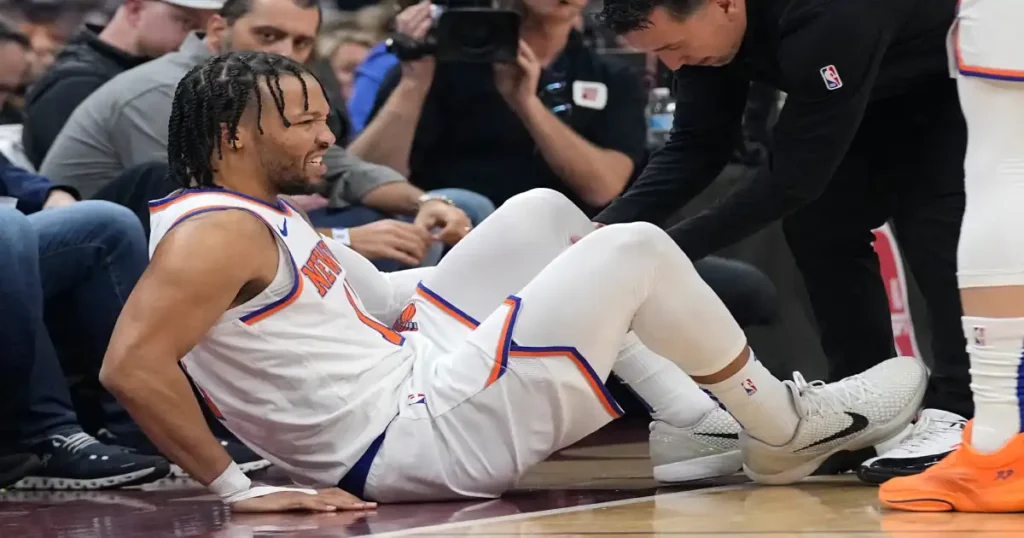
New York Knicks guard Jalen Brunson was forced to leave the game early after sustaining an ankle injury, creating immediate concern among fans and the organization as the team awaits further medical evaluation. The incident occurred during live play, when Brunson appeared to land awkwardly, prompting visible discomfort and a brief stoppage as team staff attended to him on the court.
Brunson, who has been a central figure in the Knicks’ recent success, exited the game under his own power but did not return. While initial reactions on social media ranged from alarm to speculation, the Knicks maintained a cautious and measured tone following the game, emphasizing that more information would be available after a full medical assessment.
What Happened on the Court
The injury occurred in the flow of play, with no contact that immediately suggested a serious collision. Brunson was seen grabbing at his ankle and signaling to the bench shortly afterward. Knicks medical staff evaluated him on the sideline before ruling him out for the remainder of the game as a precaution.
Head coach Tom Thibodeau addressed the situation briefly in his postgame remarks, stating that Brunson would undergo further evaluation and that the team would not speculate on the severity until imaging and tests were completed. “We’ll see how he responds,” Thibodeau said, reinforcing the team’s wait-and-see approach.
Brunson has been one of the Knicks’ most reliable performers, both statistically and as a floor leader. As the team’s primary ball handler and late-game decision-maker, his availability has had a direct impact on offensive efficiency and overall rhythm. Beyond scoring, Brunson’s ability to control tempo and create opportunities for teammates has been a defining element of New York’s game plan.
Any potential absence, even short-term, would require adjustments to the rotation. Guards further down the depth chart may be asked to take on expanded roles, while the team could lean more heavily on defensive intensity and half-court execution to compensate.
At this stage, the Knicks have not provided a detailed diagnosis. Ankle injuries can range widely in severity, from minor sprains requiring minimal rest to more significant issues that involve longer recovery timelines. Team sources indicated that the decision to hold Brunson out was made out of caution rather than certainty of a serious injury.
Medical evaluations typically include imaging to assess ligament damage and swelling, followed by day-to-day monitoring. The team is expected to update Brunson’s status once those results are reviewed.
Inside the arena, the mood shifted noticeably following Brunson’s exit. Teammates continued to compete, but the absence of their lead guard was evident in late-game execution. Fans, meanwhile, took to social platforms to express concern, reflecting Brunson’s popularity and importance to the franchise.
Despite the anxiety surrounding the injury, there was also a strong emphasis on patience. Many observers noted that Brunson’s ability to walk off the court without assistance was an encouraging sign, though not a definitive indicator of severity.
The Knicks’ immediate focus will be on Brunson’s recovery and availability for upcoming games. Until an official update is released, the team is expected to prepare contingency plans while hoping for a favorable outcome.
For now, the situation remains fluid. Brunson’s injury is a reminder of how quickly circumstances can change in the NBA, and how vital depth and adaptability are over the course of a long season. As the Knicks await further information, all eyes will be on the next medical update to determine what this moment means for both Brunson and the team moving forward.